Are you a Bachelor of Science in Nursing (BScN) graduate in Kenya preparing for the Nursing Council of Kenya (NCK) licensure examination? The NCK exam is your gateway to practicing as a registered nurse, testing advanced clinical reasoning, evidence-based practice, and decision-making skills at degree level.
Unlike diploma-level (KRCHN) exams, the BScN papers emphasize higher-order thinking, research interpretation, management, and complex patient scenarios. With exams scheduled for February 20, 2026 and May 15, 2026 (two papers per sitting), early and smart preparation is essential.
ReviQuiz is Kenya’s leading NCK revision platform, offering BScN-specific MCQs borrowed and adapted from recent NCK papers and university sources, complete with detailed rationales. No more guessing with outdated PDFs—practice in a realistic, mobile-friendly format that builds real understanding.
Ready to pass on your first try? Explore our BScN revision courses here: https://reviquiz.com/bscn/
What is the NCK Licensure Exam for BScN Graduates?
The Nursing Council of Kenya (NCK) licensure examination is the mandatory national test that every qualified nurse must pass before they can legally practise as a registered nurse in Kenya.
Established under the Nurses and Midwives Act (Cap 257 of the Laws of Kenya), the NCK is the sole professional regulatory body for all nursing and midwifery cadres in the country. Its mandate is clear: ensure that nurses entering the workforce are competent, safe, and fit to practise.
For holders of a Bachelor of Science in Nursing (BScN) degree, this means sitting a two-paper examination that tests not only your clinical knowledge but your ability to think critically, reason through complex patient scenarios, and apply evidence-based practice — the hallmarks of degree-level nursing education.
Key point: Passing the NCK exam is not optional. No licence = no practice. No exceptions.
Who Must Sit the BScN NCK Exam?
You must sit the BScN NCK examination if you are:
- A graduate of a Bachelor of Science in Nursing (BScN) programme from a Kenyan university (e.g., University of Nairobi, KU, MKU, JKUAT, Aga Khan University, etc.)
- A BScN graduate from an internationally accredited institution seeking NCK registration in Kenya
- A nurse holding a lower cadre qualification who has upgraded to BScN level and is seeking re-registration at degree level
If you hold a KRCHN diploma, you sit a different exam under a different cadre ; see Section 3 below for a full comparison.
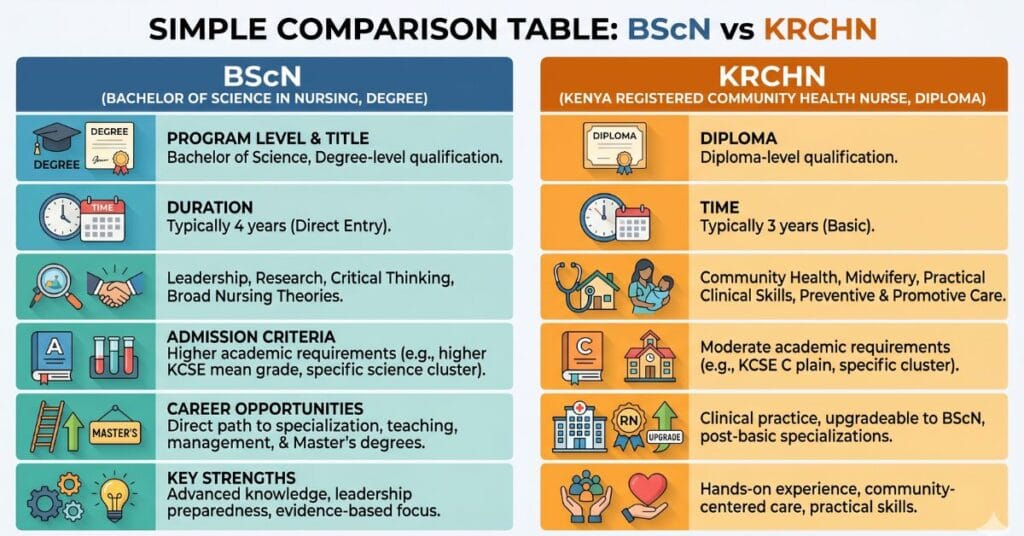
3. BScN vs KRCHN : Understanding the Difference
This is one of the most common points of confusion for candidates. Many study the wrong materials simply because they are unclear on which cadre they belong to.
| Feature | BScN (Degree) | KRCHN (Diploma) |
|---|---|---|
| Full Name | Bachelor of Science in Nursing | Kenya Registered Community Health Nurse |
| Programme Duration | 4 years (university) | 3 years (KMTC / nursing college) |
| Exam Papers | Paper 1 & Paper 2 | Paper 1 & Paper 2 |
| Question Difficulty | Higher-order clinical reasoning, EBP | Core clinical knowledge and community health |
| Content Emphasis | Advanced Med-Surg, leadership, research, critical care | Community health, primary care, fundamentals |
| Registration Title | Registered Nurse (degree) | Kenya Registered Community Health Nurse |
The bottom line: If you studied at a university and hold or are completing a BScN degree — you sit the BScN NCK exam and you must use BScN-specific revision materials. Using KRCHN materials will leave gaps in your preparation.
👉 Not sure which cadre applies to you? Contact us via WhatsApp for guidance.
BScN NCK Exam Structure: Paper 1 and Paper 2
The BScN NCK examination consists of two separate papers, each sitting in a single session on the same day or on consecutive days, depending on the exam schedule.
Paper 1 — Clinical Nursing Sciences
Paper 1 focuses on the foundational and clinical science content underpinning nursing practice. This typically includes:
- Anatomy & Physiology (applied clinical anatomy)
- Pathophysiology and disease processes
- Pharmacology and drug therapy
- Microbiology and infection control
- Medical-Surgical Nursing (adult health)
- Fundamentals of Nursing
- First Aid and Emergency Care
- Nutrition and Dietetics
Paper 2 — Applied Nursing Practice
Paper 2 moves into applied practice, specialties, and the professional domains of degree-level nursing:
- Community Health Nursing and Public Health
- Maternal and Newborn Health (Midwifery principles)
- Paediatric and Child Health Nursing
- Mental Health and Psychiatric Nursing
- Nursing Leadership and Management
- Nursing Research and Evidence-Based Practice (EBP)
- Ethics, Law, and Professionalism
- Health Systems and Policy
Important: The NCK does not publish an official question-by-question syllabus breakdown. The distribution above is based on past paper analysis and current NCK exam trends. ReviQuiz MCQs are built around this distribution.
Both papers are multiple-choice questions (MCQs), delivered on computer at approved examination centres. Each session runs for two hours (9:00 AM to 11:00 AM and 2:00 PM to 4:00 PM).
Core Subjects Tested in the BScN NCK Exam
As a BScN candidate, you are expected to demonstrate a higher level of clinical reasoning than diploma-level cadres. The NCK tests your ability to analyse patient scenarios, apply evidence, and make sound clinical decisions — not just recall facts.
The following subjects are consistently high-yield across both papers:
🔴 High Priority (Appear in Almost Every Exam)
- Medical-Surgical Nursing — Adult diseases: cardiovascular, respiratory, endocrine, renal, neurological, GIT. Expect case-based scenario questions.
- Pharmacology — Drug classifications, mechanisms of action, dosage calculations, contraindications, and nursing implications.
- Anatomy & Physiology — Applied to clinical scenarios. Expect questions that link anatomy to disease or nursing intervention.
- Community Health Nursing — Disease prevention, health promotion, epidemiology, primary healthcare, Kenya health system.
- Maternal and Newborn Health — ANC, labour management, postnatal care, neonatal assessment.
- Paediatric Nursing — Growth and development, IMCI, immunisation schedules, common childhood illnesses.
🟡 Medium Priority (Regularly Tested)
- Mental Health Nursing — Psychiatric disorders, therapeutic communication, legal aspects of psychiatric care.
- Nursing Research & EBP — Research terminology, study designs, evidence appraisal. This is uniquely weighted for BScN candidates.
- Leadership & Management — Management theories, delegation, staffing, quality improvement.
- Fundamentals of Nursing — Basic nursing care, infection control, wound care, documentation.
🟢 Always Include (Smaller but Consistent Weight)
- Ethics and Professionalism — Nursing codes of conduct, patient rights, legal aspects.
- Nutrition — Nutritional assessment, therapeutic diets, malnutrition.
- Pathology and Microbiology — Cellular injury, inflammation, infectious agents, resistance.
Pro tip: BScN candidates are frequently caught off-guard by research and EBP questions. Many come from a clinical background and neglect nursing research entirely. Don’t make that mistake — ReviQuiz includes dedicated research MCQs with rationales.
NCK Exam 2026: Key Dates for BScN Candidates
The NCK conducts examinations in multiple sessions across the year. For 2026, two sessions have been confirmed:
February 2026 Session (Resit / First Sitting)
| Milestone | Date |
|---|---|
| Application Opens | 10th November 2025 |
| Application Deadline | 31st December 2025 |
| Withdrawal Deadline | 23rd January 2026 |
| Mock Exams | 2nd – 6th February 2026 |
| Rehearsals | 17th February 2026 |
| BScN Main Exam | 20th February 2026 |
| Declaration of Results | 31st March 2026 |
May 2026 Session
| Milestone | Date |
|---|---|
| BScN Main Exam | 13th May 2026 |
| Rehearsals | 20th May 2026 |
| Declaration of Results | 30th June 2026 |
Always verify dates with the official NCK portal at nckenya.com or through your institution. Dates are subject to change at NCK’s discretion.
The exam fee is KSh 8,000 per programme as per the NCK Service Charter (2025 revision). Late registration attracts an additional penalty fee.
How the Exam Is Delivered (Computer-Based Testing)
Since 2021, the NCK has moved to computer-based testing (CBT) for its licensure examination. This is an important shift that many candidates do not adequately prepare for.
Key things to know about exam day:
- Platform: You will sit at a designated laptop at an approved examination centre. Only the NCK exam system should be open — no other applications or browsers.
- Timing: You have exactly 2 hours per paper. Time management is critical.
- Question Format: All MCQs with four options. There is no negative marking confirmed, but questions are designed to test reasoning — avoid random guessing without elimination.
- Identification: You must bring both your NCK Exam Card and a valid National ID or Passport.
- Dress Code: Kenya-trained nurses must wear their school uniform or official nurses’ uniform. Casual attire is not permitted.
- Punctuality: Arrive at least one hour before your scheduled session. Late arrival may result in denial of entry.
- Prohibited Items: No notes, books, personal phones, or unauthorised applications.
Why CBT Practice Matters
The computer-based format changes your exam psychology. Reading on a screen is different from paper. Navigating between questions, flagging uncertain ones, and managing a live countdown timer all add pressure.
ReviQuiz is built entirely as a computer-based platform — every quiz and mock exam you do on ReviQuiz replicates the CBT environment, including timed sessions and instant result feedback.
8. The Biggest Mistakes BScN Candidates Make
Understanding what others do wrong is as valuable as knowing what to do right.
Mistake 1: Using KRCHN Materials
BScN questions are calibrated to degree-level thinking. They emphasise clinical decision-making, nursing research, leadership, and evidence-based practice. Generic or KRCHN-level content will leave you underprepared for questions that require higher-order reasoning.
Mistake 2: Chasing “NCK Past Papers” Online
Many websites claim to offer “official NCK past papers.” The reality? NCK exam questions are confidential and never officially released. What circulates online is often recycled, incorrect, or badly formatted content that can actually mislead your preparation.
What ReviQuiz offers instead is a question bank built from NCK exam patterns, recent university past papers, and clinical case analysis — aligned to what the exam actually tests.
Mistake 3: Starting Too Late
The most common regret we hear from candidates who had to resit: “I started revising two weeks before the exam.” Two weeks is not enough for a two-paper, 4,000+ MCQ exam covering 20+ subject areas.
Start at least 8–12 weeks before your exam date. ReviQuiz courses are designed to fit a structured 60–90 day revision schedule.
Mistake 4: Passive Revision (Reading Only)
Reading notes and textbooks feels productive — but the NCK tests application, not recitation. You must practise answering MCQs under timed conditions, review rationales, and identify weak topics early.
Mistake 5: Ignoring Research and EBP
Most BScN candidates come from clinical placements and feel confident on Medical-Surgical and Pharmacology content. Nursing research and EBP questions catch them off-guard. These subjects consistently appear in the BScN exam and are often the margin between a pass and a fail.
9. How to Prepare for the BScN NCK Exam: A Proven Strategy
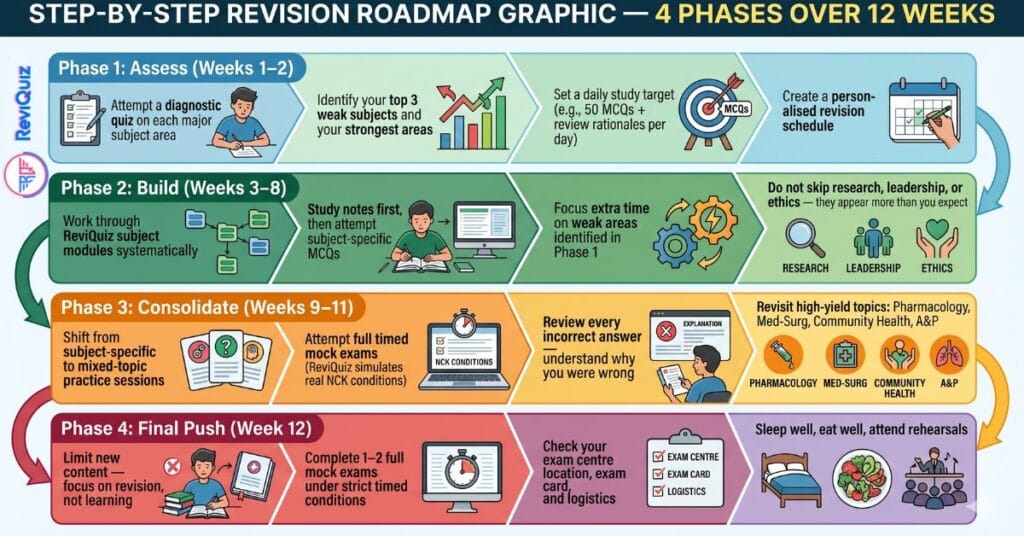
Here is a structured, evidence-informed approach to BScN NCK exam preparation:
Phase 1: Assess (Weeks 1–2)
- Attempt a diagnostic quiz on each major subject area
- Identify your top 3 weak subjects and your strongest areas
- Set a daily study target (e.g., 50 MCQs + review rationales per day)
- Create a personalised revision schedule
Phase 2: Build (Weeks 3–8)
- Work through ReviQuiz subject modules systematically
- Study notes first, then attempt subject-specific MCQs
- Focus extra time on weak areas identified in Phase 1
- Do not skip research, leadership, or ethics — they appear more than you expect
Phase 3: Consolidate (Weeks 9–11)
- Shift from subject-specific to mixed-topic practice sessions
- Attempt full timed mock exams (ReviQuiz simulates real NCK conditions)
- Review every incorrect answer — understand why you were wrong
- Revisit high-yield topics: Pharmacology, Med-Surg, Community Health, A&P
Phase 4: Final Push (Week 12)
- Limit new content — focus on revision, not learning
- Complete 1–2 full mock exams under strict timed conditions
- Check your exam centre location, exam card, and logistics
- Sleep well, eat well, attend rehearsals
Download tip: ReviQuiz Premium and Pro plans include downloadable revision resources to complement your online MCQ practice.
10. Why Generic Revision Materials Fail Degree Nurses
There is no shortage of NCK revision content online — Facebook groups, PDF question banks, Telegram channels, YouTube channels. So why do so many BScN candidates still fail or have to resit?
The problem is quality and alignment.
Generic materials typically suffer from:
- Outdated content that doesn’t reflect current NCK exam trends
- Incorrect answers with no rationales
- KRCHN-level questions mislabelled as suitable for BScN
- No structured progression from basic to advanced reasoning
- No simulation of the computer-based exam environment
ReviQuiz was built specifically for Kenyan nursing licensure candidates. Every question is:
- Aligned to the current NCK exam blueprint
- Available for BScN Paper 1 and Paper 2 separately
- Accompanied by a full clinical rationale explaining the correct and incorrect options
- Compiled from NCK exam patterns and recent university past papers
- Delivered on a timed, computer-based platform that mirrors the real exam
11. BScN NCK Revision Courses on ReviQuiz
ReviQuiz offers multiple pathways for BScN preparation — from affordable standalone MCQ banks to full revision packages with notes, mocks, and resources.
Option A: MCQ Question Banks Only (No Notes)
Ideal if you already have solid revision notes and just need quality practice questions.
| Course | Questions | Price | Access |
|---|---|---|---|
| BScN Paper 1 MCQs | 500+ | KSh 600 | 30 Days |
| BScN Paper 2 MCQs | 500+ | KSh 600 | 30 Days |
Get both Paper 1 + Paper 2 for KSh 1,200 — the smartest standalone option.
Option B: Full Revision Packages (Notes + MCQs + Mocks)
Best for candidates who want structured notes, a large MCQ bank, and multiple mock exams in one package.
| Package | Questions | Mock Exams | Price | Access |
|---|---|---|---|---|
| NCK Basic | 1,000+ | 2 | KSh 1,500 | 30 Days |
| NCK Premium | 2,500+ | 5 | KSh 3,500 | 60 Days |
| NCK Pro | 4,000+ | 8 | KSh 5,000 | 90 Days |
Option C: Subject-Specific Modules
Target your weakest areas with standalone specialty courses (KSh 500 each, 30-day access):
- Medical-Surgical Nursing
- Community Health Nursing
- Midwifery Nursing
- Paediatric Nursing
- Pharmacology
- Anatomy & Physiology
All courses are paid via M-Pesa. Access begins immediately after payment. No waiting. No shipping. Study from your phone or laptop, anywhere in Kenya.
12. Sample BScN NCK Exam Questions (with Rationales)
Here are three sample questions representative of the BScN NCK exam standard. Attempt each before reading the rationale.
Question 1 — Pharmacology
A patient on warfarin therapy comes to the ward with an INR of 4.8. They have no active bleeding. What is the most appropriate nursing action?
A) Administer the next scheduled dose of warfarin as usual
B) Hold warfarin and notify the physician
C) Administer Vitamin K immediately without physician order
D) Increase the frequency of INR monitoring and continue warfarin
Correct Answer: B
Rationale: An INR of 4.8 is supratherapeutic (therapeutic range is typically 2.0–3.0 for most indications). Even without active bleeding, the risk of haemorrhage is significant. The correct action is to withhold the next warfarin dose and notify the prescribing physician. Administering Vitamin K (Option C) is a medical decision and should not be done without a physician’s order. Continuing warfarin (Option D) could be dangerous.
Question 2 — Nursing Research (BScN-Specific)
A nurse is reviewing a study comparing two wound dressings. The study reports a p-value of 0.03. What does this finding indicate?
A) The results are clinically significant
B) There is a 3% probability the results occurred by chance
C) The study has a large sample size
D) The results are not statistically significant
Correct Answer: B
Rationale: A p-value indicates the probability that the observed results occurred by chance under the null hypothesis. A p-value of 0.03 means there is a 3% chance the result is due to random variation — below the conventional threshold of 0.05, making the result statistically significant. Statistical significance does not automatically equal clinical significance (Option A). Sample size is not indicated by the p-value (Option C).
Question 3 — Community Health Nursing
A community health nurse is planning a measles vaccination campaign in a rural sub-county. Which strategy best reflects the primary level of prevention?
A) Treating children diagnosed with measles complications
B) Conducting school health screenings to detect unvaccinated children
C) Administering measles vaccines to all children aged 9–15 months
D) Providing physiotherapy to children with measles-related sequelae
Correct Answer: C
Rationale: Primary prevention refers to actions taken before disease occurs to prevent its development — vaccination is the classic example. Option A (treating complications) is tertiary prevention. Option B (screening) is secondary prevention. Option D (rehabilitation) is also tertiary prevention.
Want 500+ more questions like these, with full rationales? Start with BScN Paper 1 MCQs for KSh 600
13. Frequently Asked Questions
Can I use KRCHN materials to prepare for the BScN NCK exam?
No. While there is some overlap in foundational content, BScN questions are calibrated to degree-level clinical reasoning. They include nursing research, evidence-based practice, advanced clinical management, and leadership — all at a higher cognitive level. Using KRCHN-only materials will leave significant gaps in your preparation.
How many times a year does the NCK conduct exams?
The NCK typically conducts examinations three times per year — in February/March, May/June, and August/November. The confirmed 2026 sessions so far are February 2026 and May 2026.
Do I need to pass both Paper 1 and Paper 2 to get licensed?
Yes. Both papers must be passed. If you fail one paper, you may be eligible to resit that specific paper in the next session without repeating the one you passed — confirm the current NCK policy on resits via nckenya.com.
Are ReviQuiz questions taken directly from official NCK past papers?
NCK exam questions are confidential and not officially released. ReviQuiz MCQs are built from NCK exam patterns, recent university past papers (including from AMREF and other accredited institutions), and clinical case analysis — designed to reflect the current difficulty level and topic distribution of the actual exam.
Can I access ReviQuiz on my phone?
Yes. ReviQuiz is fully mobile-optimised. You can study from any smartphone or laptop, at any time.
How do I pay for ReviQuiz courses?
All courses are paid via M-Pesa. After payment, access is granted immediately. You can also order via WhatsApp if you need assistance.
What if I fail my NCK exam?
First — it’s more common than you think, and it is not the end. Many successful nurses have had to resit. The key is understanding where you went wrong and addressing those gaps strategically before the next sitting. ReviQuiz can help you identify weak areas and build back up. Read our NCK Resit Guide for practical advice
What is the difference between the BScN NCK Basic, Premium, and Pro packages?
The main differences are the number of MCQs, number of mock exams, and access period. Basic (KSh 1,500) gives 1,000 MCQs and 2 mocks for 30 days. Premium (KSh 3,500) gives 2,500 MCQs and 5 mocks for 60 days. Pro (KSh 5,000) gives 4,000+ MCQs and 8 mocks for 90 days. For serious candidates with 2+ months before their exam, the Premium or Pro package offers the best value. See full course details
14. Conclusion: Your Licence is One Exam Away
The BScN NCK licensure examination is not something to approach casually. Four years of nursing education has brought you to this point, and one well-prepared exam attempt is what stands between you and a career as a licensed Registered Nurse in Kenya.
The candidates who pass are not always the most academically gifted. They are the ones who:
- Started early
- Practised consistently with quality MCQs
- Understood why answers were right or wrong — not just what the answer was
- Used revision materials built specifically for the BScN exam standard
ReviQuiz exists to give every Kenyan nursing graduate — regardless of where they are in the country — access to that quality preparation. Affordable. Mobile-friendly. M-Pesa powered. Built for you.
Ready to Start Your BScN NCK Revision?
Browse All BScN Revision Courses on ReviQuiz →
Or jump straight in:
- BScN Paper 1 MCQs — KSh 600
- BScN Paper 2 MCQs — KSh 600
- NCK Premium Package (Best Value) — KSh 3,500
Pay via M-Pesa. Start studying in minutes.
Have a question about BScN NCK exam preparation? Contact us via WhatsApp or drop us a message on the Contact page.
Why Traditional Past Papers & PDFs Are Not Enough for BScN
Many students rely on old PDF compilations of NCK past papers. While useful for familiarity, they have major drawbacks:
- Outdated content that doesn’t match the current computer-based test (CBT) format.
- No detailed rationales explaining why answers are correct (or incorrect).
- Risk of errors, missing updates, or questions that no longer align with NCK blueprints.
- Poor for building clinical judgment needed for BScN-level scenarios.
ReviQuiz takes a smarter approach: Questions are carefully adapted from recent NCK and university papers, paired with in-depth rationales, progress tracking, and mock exams that simulate the real proctored environment. This is the “beyond past papers” method that actually improves scores.
Video suggestion: Embed or link a short YouTube-style revision clip (e.g., sample BScN Paper 2 breakdown on shock or cold chain). If unavailable, add a placeholder: “Insert 2–3 minute demo video of ReviQuiz platform here.”
How ReviQuiz Helps You Ace the BScN NCK Exam
ReviQuiz is built specifically for Kenyan nursing students. Our BScN page offers:
- Dedicated BScN Paper 1 & Paper 2 Question Banks
- 500+ MCQs each with answers and detailed rationales.
- KSh 600 per bank, 30-day access. Perfect for targeted practice.
- Full NCK Revision Packages (BScN-optimized)
- Basic: KSh 1,500 – 1,000+ MCQs, 2 mock exams (30 days).
- Premium: KSh 3,500 – 2,500+ MCQs, 5 mock exams, resources (60 days).
- Pro: KSh 5,000 – 4,000+ MCQs, 8 mock exams, lecture videos & unlimited downloads (90 days).
- Specialized Nursing Modules (great supplements for weak areas)
- Medical-Surgical, Community Health, Midwifery, Paediatric, Pharmacology, Anatomy & Physiology – each with notes + practice questions (KSh 500).
All content is mobile-friendly, payable via M-Pesa, and gives instant access. Many questions draw directly from NCK-style scenarios and recent university papers for relevance.
Don’t leave your licensure to chance. Start with the BScN Paper 1 MCQs or enroll in the Premium Package today: https://reviquiz.com/bscn/
Proven Tips to Pass Your BScN NCK Exam in 2026
- Master the Nursing Process (ADPIE) and prioritization frameworks—common in scenario-based questions.
- Focus on high-yield topics: Shock management, pharmacology implications, reproductive health, community health programs, and evidence-based interventions.
- Practice under timed conditions with rationales to learn from mistakes.
- Supplement with recommended textbooks available on ReviQuiz (e.g., Brunner & Suddarth’s Medical-Surgical Nursing, Potter & Perry Fundamentals, Guyton & Hall Physiology).
- Join study groups and use analytics in ReviQuiz to track weak areas.
Students using rationale-rich practice consistently outperform those relying solely on answer keys.
Why Choose ReviQuiz Over Other NCK Revision Options?
- Localized for Kenyan BScN context (not generic NCLEX-style).
- Affordable and flexible—start small with single modules or go all-in with Pro.
- Emphasis on understanding through rationales, not just memorization.
- Regular updates aligned with current NCK syllabus and exam format.
- Positive feedback from users preparing for 2026 sittings.
Compared to scattered PDFs or basic apps, ReviQuiz provides a complete, structured system designed to help you pass and become a competent, confident nurse.
Ready to Pass Your NCK BScN Exam?
The February and May 2026 NCK exams are approaching fast. Give yourself the best chance with targeted, rationale-driven revision.
Take action now:
- Visit the BScN Revision Hub: https://reviquiz.com/bscn/
- Enroll in BScN Paper 1 or Paper 2 MCQs → [Direct links from your courses page]
- Upgrade to NCK Premium/Pro for full coverage.
- Browse supporting textbooks: [https://reviquiz.com/ (shop section)]
Follow us for free daily NCK questions and tips: Instagram @ReviQuiz | Facebook | X (@ReviQuiz)
Have questions? Contact us: https://reviquiz.com/contact/
Final CTA: Start revising smarter today. Your NCK success story begins at ReviQuiz.